


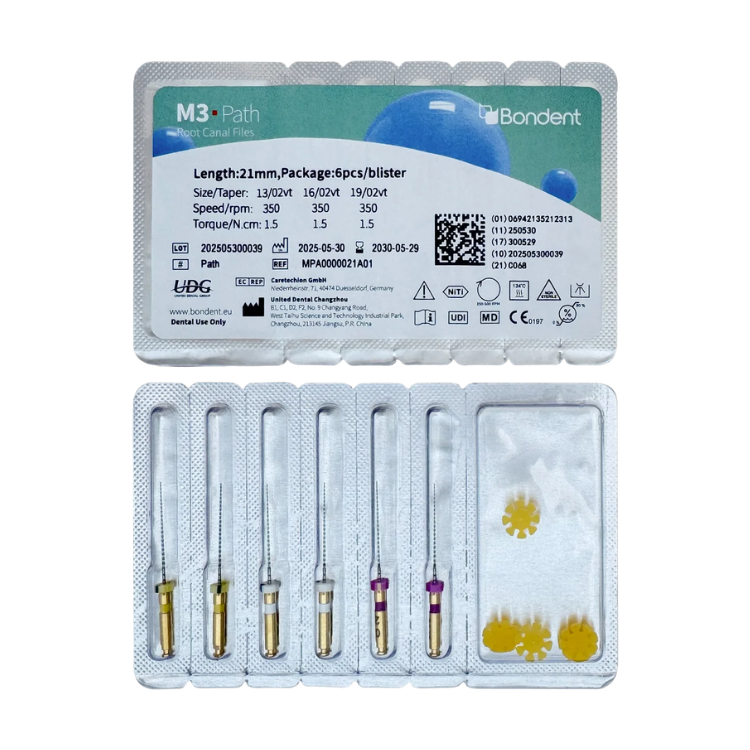
M3 Safe Path Files – Bondent UDG NiTi Glide Path Files
- NiTi glide path files: Bondent M3 Safe Path Files are designed for controlled mechanical glide path preparation before larger root canal shaping instruments.
- Flat-side design: The specialised geometry helps reduce the screw-in effect while supporting improved debris removal during instrumentation.
- Three core sizes: Available in #10, #13 and #16 configurations for progressive glide path preparation.
- Multiple working lengths: Choose from 21 mm, 25 mm and 31 mm lengths to suit different canal treatment requirements.
- Easy identification: ISO colour coding helps clinicians quickly identify instrument sizes during sequential endodontic procedures.
KSh2,200.00
Product Description
M3 Safe Path Files for Glide Path Preparation
M3 Safe Path Files are Bondent UDG nickel-titanium files designed for controlled glide path preparation before root canal shaping. The system uses a specialised flat-side design to improve debris removal while reducing the screw-in effect during instrumentation.
The files are available in #10, #13 and #16 sizes, with 21 mm, 25 mm and 31 mm lengths. They also feature ISO colour coding on the instrument shank, helping clinicians identify file sizes quickly during treatment.
The system is designed to create a reproducible pathway before introducing larger shaping instruments. This makes it a useful preparation stage within rotary endodontic workflows.
Why Choose M3 Safe Path?
A reliable glide path helps prepare the canal for subsequent shaping instruments. The M3 range focuses on controlled canal negotiation while maintaining efficient debris removal.
The files feature a flat-side design that helps reduce resistance and the screw-in effect. This design also supports debris removal during instrumentation.
Key Benefits
- NiTi construction: Manufactured from nickel-titanium alloy for use in mechanical endodontic preparation.
- Flat-side design: Helps reduce the screw-in effect while supporting debris removal.
- Three core sizes: Available in #10, #13 and #16 configurations for progressive glide path preparation.
- ISO colour identification: Colour coding makes file-size identification easier during treatment.
- Multiple working lengths: Available in 21 mm, 25 mm and 31 mm lengths.
- Designed for glide path preparation: Provides a controlled pathway before larger shaping files are introduced.
- Class IIa, CE and ISO: Bondent identifies the product as Class IIa and CE/ISO certified.
Flat-Side Design for Controlled Instrumentation
The flat-side geometry is one of the defining features of M3 Safe Path Files.
A flat side can reduce the surface area contacting the canal wall. Therefore, the instrument can move through the canal with less tendency to pull itself deeper into the canal.
Bondent specifically states that the design increases debris removal and reduces screw-in effects.
This makes the files suitable for clinicians who want greater control during mechanical glide path preparation.
Available Sizes and Lengths
The range includes three main file sizes:
| File | ISO Size | Typical Role |
|---|---|---|
| P1 | #10 | Initial mechanical glide path |
| P2 | #13 | Progressive canal enlargement |
| P3 | #16 | Further glide path preparation |
Bondent's current product page lists #10vt, #13vt and #16vt models and confirms availability in 21 mm, 25 mm and 31 mm lengths.
Product documentation and market listings may use slightly different model or taper notation. Always verify the specific reference number and configuration supplied with the product.
ISO Colour Coding
The instruments are marked using ISO colour identification according to tip size.
This makes it easier to distinguish instruments during a multi-step endodontic procedure. It can also help reduce confusion when several files are being used sequentially.
For a busy clinical environment, clear size identification supports a more organised instrumentation workflow.
M3 Safe Path Clinical Workflow
The files can be incorporated into a structured glide path procedure.
Step 1 – Establish Initial Canal Negotiation
Begin with appropriate hand instrumentation to explore and negotiate the canal.
A preliminary manual glide path should be established according to the clinician's preferred endodontic protocol.
Step 2 – Determine Working Length
Determine the working length using an appropriate apex locator and radiographic confirmation where clinically indicated.
Step 3 – Irrigate
Irrigate the canal before introducing the mechanical glide path instrument.
Adequate irrigation and frequent cleaning of the flutes are important during mechanical preparation.
Step 4 – Begin With the Smaller File
Start with the appropriate smaller instrument and advance carefully according to the canal anatomy and clinical protocol.
Use light pressure and allow the instrument to follow the established canal path.
Step 5 – Progress Through the Sequence
Progress through the available sizes as indicated by the canal anatomy and treatment protocol.
The commonly referenced sequence progresses from #10 to #13 and then #16.
Step 6 – Irrigate and Recapitulate
Irrigate frequently and recapitulate as required.
This helps maintain canal patency and remove accumulated debris.
Step 7 – Confirm the Glide Path
Once the desired glide path has been established, confirm working length and proceed to the selected canal-shaping system.
Always follow the current manufacturer's instructions for use and the clinical protocol applicable to the selected instrumentation system.
M3 Safe Path and Root Canal Shaping
Glide path preparation is an important stage before mechanical canal shaping.
A controlled pathway can help subsequent shaping instruments negotiate the canal more predictably. Therefore, these files can be used before systems such as Bondent M3 shaping files or other compatible rotary systems.
For example, a typical workflow may include:
Hand file → Glide path → Canal shaping → Irrigation → Obturation
The exact sequence should always depend on the canal anatomy, file system and clinician's preferred technique.
Technical Specifications
| Specification | Details |
|---|---|
| Product | M3 Safe Path Files |
| Manufacturer / Brand | Bondent / UDG |
| Product family | Endodontics |
| Instrument type | NiTi glide path file |
| Material | Nickel-titanium alloy |
| Available sizes | #10, #13, #16 |
| Available lengths | 21 mm, 25 mm, 31 mm |
| Design | Flat-side design |
| Identification | ISO colour coding |
| Primary application | Glide path preparation |
| Key design benefit | Increased debris removal and reduced screw-in effect |
| Certification | Class IIa, CE, ISO |
The official Bondent specification confirms the three models, three available lengths and certification.
Recommended Operating Parameters
The manufacturer's instructions should always take priority for speed, torque, usage and reprocessing.
Available product instructions reference constant rotation at approximately 300 rpm, with light pressure and frequent flute cleaning. They also recommend establishing a manual glide path before mechanical use.
Important Clinical Precautions
- Establish an appropriate manual glide path before mechanical instrumentation.
- Use light pressure.
- Irrigate abundantly and frequently.
- Clean the flutes regularly.
- Inspect instruments for distortion or wear.
- Do not continuously immerse the instruments in sodium hypochlorite.
- Follow the applicable manufacturer's instructions for cleaning, sterilisation and reuse.
- Do not use damaged or visibly deformed instruments.
- Always follow the current IFU supplied with the product.
Because file performance can depend on canal anatomy, motor settings and clinical technique, the manufacturer's current IFU should be used as the primary reference.
Who Should Use These Files?
M3 Safe Path Files are suitable for dental professionals performing mechanical root canal treatment, particularly clinicians who want a dedicated glide path stage before canal shaping.
They can be useful in:
- General dental practices
- Endodontic clinics
- Specialist dental centres
- Multi-chair dental practices
- Rotary endodontic workflows
- Routine root canal treatment
- Curved canal preparation where appropriate
- Glide path preparation before rotary shaping
What Are the Advantages Over Basic Hand-Only Glide Path Preparation?
Hand files remain an important part of canal negotiation and glide path establishment. However, a mechanical glide path system can provide a more repeatable approach once the canal has been initially negotiated.
The flat-side design also addresses a practical concern during mechanical instrumentation by reducing the tendency toward a screw-in effect.
Therefore, the system can complement rather than replace appropriate manual canal negotiation.
What to Consider Before Buying
Before ordering, confirm the required file size and working length.
The range is available in 21 mm, 25 mm and 31 mm lengths. Select the appropriate length based on the clinical applications and working lengths commonly encountered in your practice.
Also confirm whether you require individual files, assorted configurations or specific reference numbers.
If your practice already uses a Bondent endodontic workflow, these instruments can be paired with compatible shaping and finishing systems from the same product family.
Frequently Asked Questions
What are M3 Safe Path Files?
M3 Safe Path Files are Bondent UDG NiTi instruments designed for mechanical glide path preparation before root canal shaping.
What sizes are available?
The range includes #10, #13 and #16 sizes.
What lengths are available?
The files are available in 21 mm, 25 mm and 31 mm lengths.
What material are the files made from?
The cutting portion is made from nickel-titanium alloy.
What is the purpose of the flat side?
The flat-side design helps reduce the screw-in effect and supports improved debris removal during instrumentation.
Are these files used before rotary shaping?
Yes. They are designed for glide path preparation before subsequent canal-shaping instrumentation.
What speed should be used?
Available instructions reference approximately 300 rpm with constant rotation. Always verify the current IFU for the exact product configuration before clinical use.
Are the files sterile?
Configuration and packaging can vary. Confirm the supplied product and current manufacturer's instructions regarding sterility and reprocessing before use.
Are M3 Safe Path Files reusable?
The applicable instructions address multiple use and reprocessing. However, repeated use can increase the risk of file separation. Follow the manufacturer's current IFU and your clinic's instrument reprocessing protocol.
Complete Your Endodontic Workflow
For a complete root canal preparation setup, consider pairing these files with:
- Stainless steel K-files
- iRoot Apex
- Endo Wise
- Endo Wise Plus
- M3 Opener
- M3 Safe Opener
- M3 Path
- M3 Pro Gold
- Endodontic irrigation needles
- Gutta-percha points
- Endodontic sealers
- Endodontic microscopes
- CBCT dental imaging
A practical workflow can therefore progress from manual canal negotiation to glide path preparation and then mechanical shaping.
Add internal links to the relevant products and endodontic categories in your WooCommerce store to help customers build a complete treatment setup.
Why Buy From TransAfrica Medical Supplies?
TransAfrica Medical Supplies supplies professional dental equipment, endodontic instruments and consumables to dental clinics across Kenya.
Our team can help you select the appropriate file configuration based on your endodontic workflow, motor system and preferred instrumentation technique.
We can also help clinics combine glide path instruments with compatible endodontic motors, apex locators, shaping files, irrigation products and obturation systems.
Order M3 Safe Path Files in Kenya
Improve your mechanical glide path workflow with M3 Safe Path Files from Bondent UDG.
With NiTi construction, ISO size identification, a flat-side design and multiple length options, the range provides a practical solution for controlled glide path preparation before root canal shaping.
Contact TransAfrica Medical Supplies for pricing, availability and professional product support in Kenya.
Reviews
Clear filtersThere are no reviews yet.