


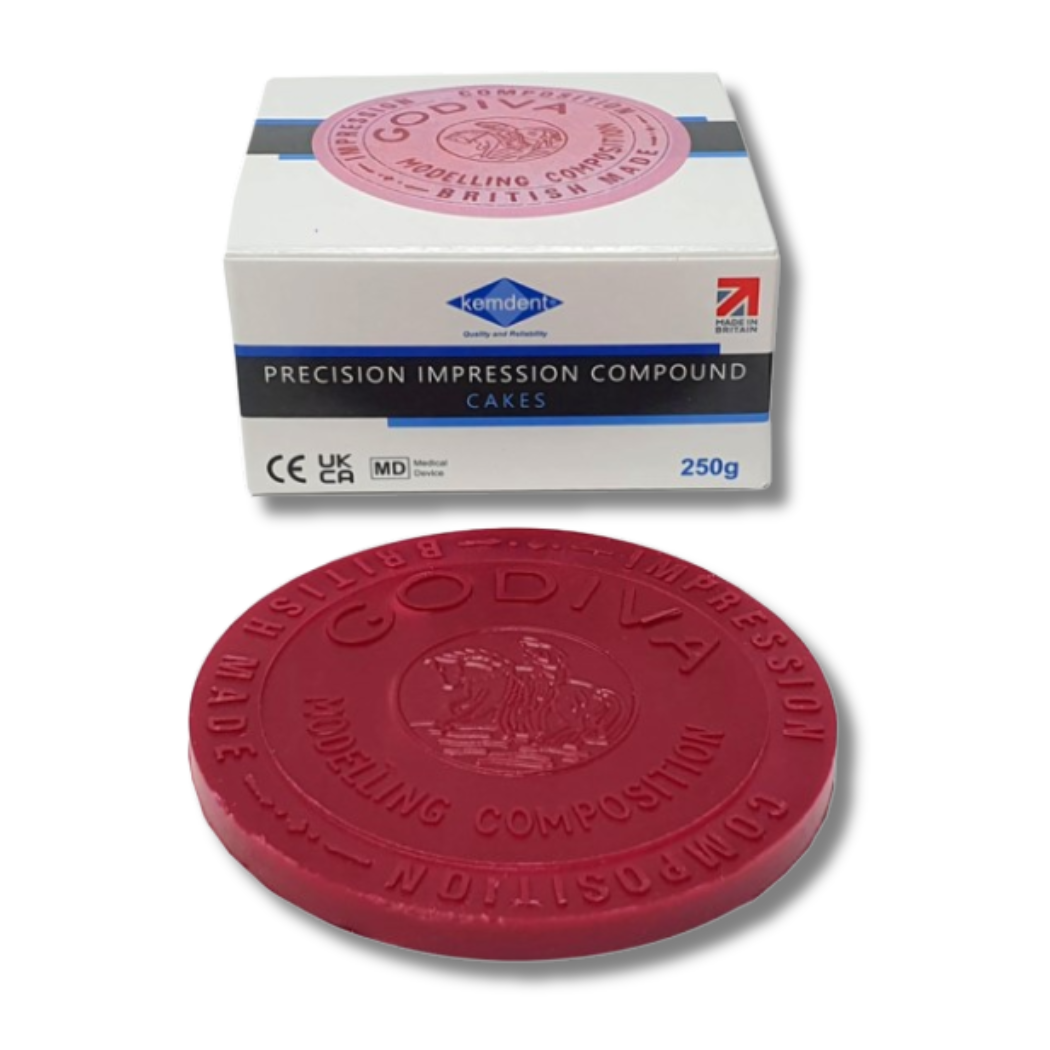
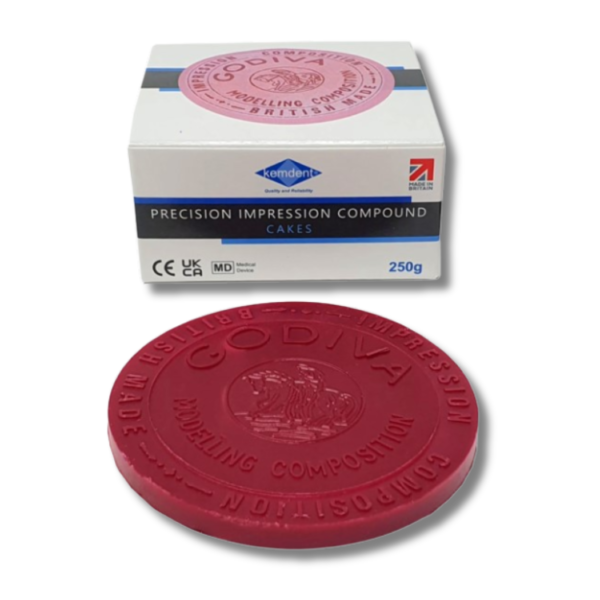
Kemdent Compound Cake
- Thermoplastic, non-elastic impression material that softens with controlled heating and becomes rigid as it cools.
- Ideal for preliminary impression procedures, particularly for edentulous patients and complete denture workflows.
- Easy to adjust and rework by reheating, allowing material to be added, removed or reshaped when required.
- Provides excellent clinical control during tray adaptation and conventional impression procedures.
- Established Kemdent quality, manufactured by a UK dental-materials specialist with more than 100 years of dental industry experience.
KSh2,200.00
Product Description
Reliable Thermoplastic Impression Material for Dental Practice
Kemdent Compound Cake is a thermoplastic, non-elastic dental impression material designed for conventional impression procedures. It softens when heated and becomes rigid again as it cools, allowing the clinician to mould and adjust the material during impression taking.
This characteristic makes impression compound particularly useful when taking preliminary impressions in edentulous patients, where the clinician needs a material that can be shaped and adapted to the impression tray and oral tissues.
Furthermore, the thermoplastic nature of the material allows adjustments to be made by reheating, adding material or removing excess material. As a result, clinicians can refine the impression rather than having to discard the entire impression after a minor adjustment.
Kemdent has been manufacturing dental materials in the UK since 1922 and supplies products for dental practices and laboratories worldwide. The company operates under an ISO 13485 quality management system, with its dental medical devices carrying UKCA and CE marking.
At TransAfrica Medical Supplies, we supply professional dental impression materials and accessories. In addition, our TransAfrica Academy provides practical product training to help dental professionals improve their clinical techniques and workflows.
Thermoplastic Impression Compound for Controlled Impressions
Unlike alginate, impression compound does not remain elastic after setting. Instead, it becomes rigid after cooling.
Therefore, it is particularly suited to procedures where the clinician wants a material that can be heated, moulded and subsequently adjusted.
The material can be:
- Heated to soften it.
- Adapted to the impression tray.
- Moulded to the required shape.
- Inserted into the mouth.
- Allowed to cool and harden.
- Reheated for further modification when necessary.
Consequently, clinicians have considerable control over the impression-making process.
Suitable for Preliminary Edentulous Impressions
Impression compound has traditionally been used for preliminary impressions of edentulous arches, particularly when preparing for complete denture treatment. Kemdent describes its impression composition range as suitable for taking impressions in edentulous cases before preparation of a special tray.
The material provides a rigid impression after cooling, which can then serve as the basis for subsequent laboratory procedures.
However, the clinician should select the appropriate impression technique and material according to the specific clinical case.
Easy to Adjust and Rework
One of the major advantages of thermoplastic impression compound is its ability to be reheated.
If the initial impression requires modification, the clinician can soften the relevant area and make the required adjustment. For example, material can be added to extend an area or removed where excessive material has been captured.
As a result, impression compound provides a degree of flexibility that is particularly useful during preliminary impression procedures.
Kemdent also highlights the ability to make alterations by removing, replacing or adding material until a satisfactory impression is achieved.
Controlled Heating for Clinical Use
Impression compound must be heated before it becomes sufficiently plastic for moulding.
The precise working temperature depends on the specific Kemdent formulation. Therefore, clinicians should always follow the manufacturer's instructions for the exact product supplied rather than applying one temperature to every impression compound.
For example, Kemdent's current KemKat impression compound specifies an ideal working temperature of approximately 50–55°C and instructs users not to overheat the material.
Importantly, heated impression compound can cause burns if handled incorrectly. Always follow the manufacturer's instructions and use appropriate clinical precautions.
Why Choose Kemdent Impression Materials?
Kemdent has a long history within dentistry, having been established in 1922. The company manufactures dental materials in the United Kingdom and supplies products to dental professionals internationally.
Its product portfolio covers dental practice and laboratory applications, including impression materials, waxes, cements, acrylics, polishing products and other dental materials.
Therefore, Kemdent impression materials are well suited to practices and laboratories looking for established dental-material solutions.
Important for Dentists and Dental Laboratories
Before purchasing impression compound, consider what you need the material to accomplish.
For clinicians
Consider:
- The type of impression required.
- Whether the patient is edentulous.
- Whether a preliminary or functional impression is needed.
- The tray being used.
- The required working characteristics.
- The heating method available in the practice.
For dental laboratories
Consider:
- The type of impression being received.
- Whether the material requires additional adjustment.
- The intended model-production workflow.
- Compatibility with the subsequent laboratory procedure.
As a result, choosing the appropriate compound formulation is more important than simply selecting an impression material based on price.
Build a Complete Impression Workflow
Kemdent impression compound can form part of a broader conventional impression workflow.
A typical process may include:
Tray selection → Compound heating → Tray adaptation → Impression taking → Cooling → Inspection → Disinfection → Laboratory processing
Furthermore, complementary products such as impression trays, alginate, impression disinfectants and laboratory materials can support the complete workflow.
At TransAfrica Medical Supplies, we can help your practice select the appropriate combination of impression materials and accessories.
Why Buy from TransAfrica Medical Supplies?
When you purchase dental materials from TransAfrica Medical Supplies, you receive access to more than product supply.
We provide:
- Genuine dental materials.
- Product selection guidance.
- Clinical application support.
- Technical assistance.
- Dental laboratory product support.
- Access to complementary impression materials.
- Biomedical engineering support where applicable.
- Training through the TransAfrica Academy.
In addition, our Academy provides practical product training designed to help dental professionals improve their clinical workflows and product handling.
Technical Specifications
Because “Kemdent Compound Cake” can refer to different Kemdent impression-composition products, the exact specifications should match the variant on your packaging. Kemdent's product documentation identifies several impression-composition products, including Kemco Precision Cakes and Godiva Red/White Cakes.
| Specification | Details |
|---|---|
| Manufacturer | Kemdent / Associated Dental Products Ltd |
| Product Type | Thermoplastic impression composition |
| Material Type | Non-elastic impression material |
| Physical Behaviour | Softens when heated; hardens when cooled |
| Primary Application | Dental impression procedures |
| Common Application | Preliminary impressions, particularly edentulous cases |
| Adjustment | Can be reheated and modified |
| Sterile | No |
| Intended Users | Dental professionals |
| Manufacturing | United Kingdom |
Frequently Asked Questions
What is Kemdent Compound Cake?
It is a thermoplastic, non-elastic dental impression material that softens when heated and becomes rigid when cooled.
What is impression compound used for?
It is commonly used for preliminary impression procedures, particularly in edentulous cases before the preparation of a special tray.
Can impression compound be reheated?
Yes. One of its key advantages is that the material can be reheated and adjusted when required.
Can I add more material to an impression?
Yes. Thermoplastic impression compound can generally be modified by adding or removing material and reheating it as appropriate. However, follow the instructions for the specific Kemdent formulation.
Is Kemdent Compound Cake elastic?
No. Impression composition is classified as a non-elastic impression material.
Is it suitable for alginate impressions?
No. It is a different class of impression material. Alginate is an irreversible hydrocolloid, whereas impression compound is a thermoplastic material.
How is impression compound softened?
It is softened using controlled heat, commonly in a water bath. The exact temperature should follow the manufacturer's instructions for the particular formulation.
Can heated impression compound burn the patient?
Yes. Excessively hot material can cause burns. Therefore, clinicians must control the heating process and follow the manufacturer's instructions carefully.
Does Kemdent make different impression compound formulations?
Yes. Kemdent's impression-composition range includes products such as Kemco Precision Cakes and Godiva Red Cakes, as well as other impression compositions and tracing sticks.
Does TransAfrica Medical provide training?
Yes. Through the TransAfrica Academy, we provide practical product and clinical workflow training to help dental professionals improve their practice.
Reviews
Clear filtersThere are no reviews yet.