


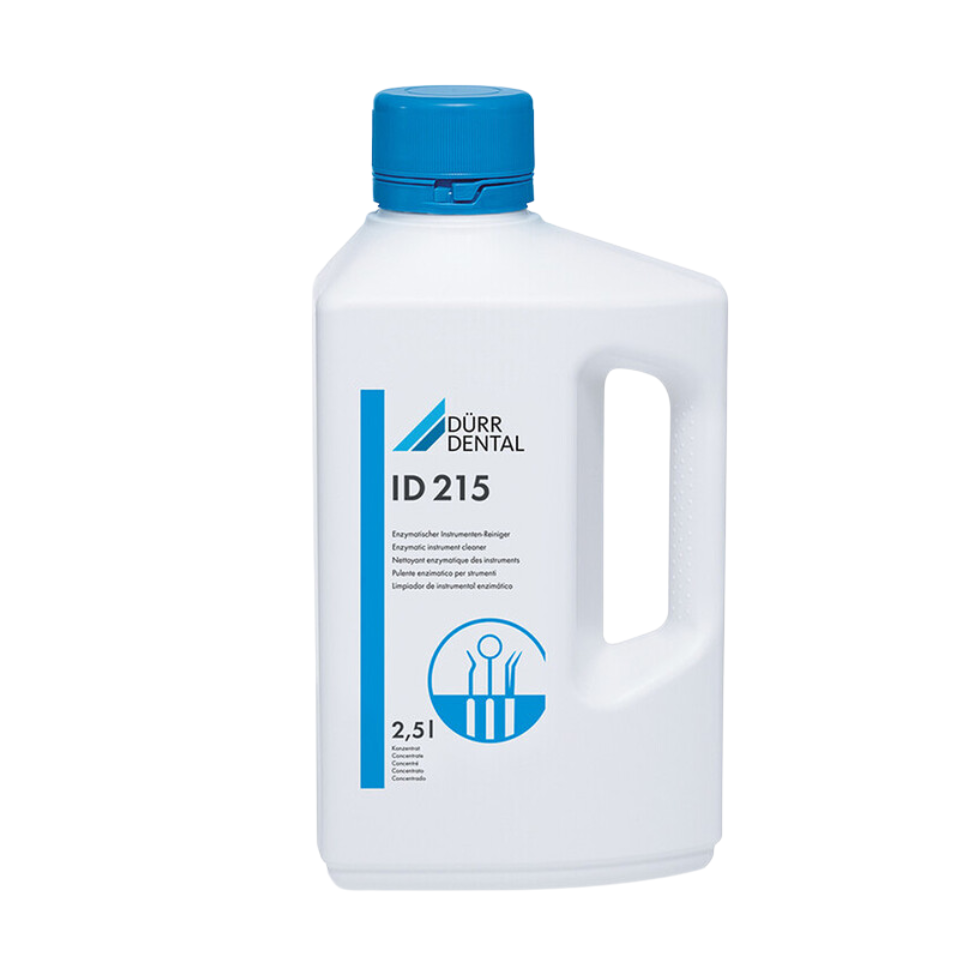
ID 215 Enzymatic Instrument Cleaner
- Enzymatic instrument cleaner: Helps break down blood, saliva and other protein-based contamination before disinfection.
- Excellent material compatibility: Particularly suitable for instruments containing rubber or silicone components.
- Flexible application: Use at 1% for 30 minutes or 2% for 15 minutes according to the manufacturer’s instructions.
- 2.5-litre concentrate: Professional cleaning solution for general, surgical and selected rotating dental instruments.
KSh11,350.00
5
People watching this product now!
Product Description
ID 215 Enzymatic Instrument Cleaner – DÜRR DENTAL
ID 215 Enzymatic Instrument Cleaner is a professional concentrate from DÜRR DENTAL for manual cleaning of dental instruments before disinfection. It is suitable for general and surgical instruments as well as selected rotating instruments. In particular, ID 215 works well with instruments that remain sensitive to alkaline and alcohol-based cleaners. The formulation also offers excellent material compatibility, especially for instruments containing rubber or silicone components. As a result, ID 215 provides dental practices with an effective solution for the first stage of instrument reprocessing.Why Choose ID 215 Enzymatic Instrument Cleaner?
Dental instruments can carry blood, saliva and other organic contamination after treatment. Therefore, effective cleaning should form an essential part of the instrument-reprocessing workflow. ID 215 contains enzymes that help break down proteins from blood and saliva. Consequently, the product helps loosen stubborn organic contamination before the disinfection stage. Furthermore, its material compatibility makes it suitable for a wide range of dental instruments. The product can also support the pre-cleaning of selected rotating instruments. Key benefits include:- Enzymatic cleaning: Helps break down proteins from blood and saliva.
- Excellent cleaning performance: Helps remove stubborn organic contamination.
- Good material compatibility: Particularly suitable for instruments with rubber or silicone components.
- Aldehyde-free formulation: Provides an alternative for professional instrument cleaning.
- Broad application: Suitable for general, surgical and selected rotating instruments.
- Flexible dosing: Use at 1% or 2% concentration according to the required application.
- 2.5-litre packaging: Suitable for regular professional use.
How ID 215 Enzymatic Instrument Cleaner Works
ID 215 uses enzymes to break down protein-based contamination. For example, the enzymes can act on residues from blood and saliva that remain on used instruments. At the same time, the product provides an antimicrobial effect during the pre-cleaning stage. DÜRR DENTAL states that this effect provides additional protection for personnel during instrument pre-cleaning. Therefore, ID 215 helps prepare instruments for the next stage of the hygiene cycle. However, cleaning does not replace disinfection or sterilisation. The practice must continue with the appropriate subsequent stages.ID 215 for Dental Instruments
Dental practices can use ID 215 for many general and surgical instruments. Examples include instruments commonly used during routine dental procedures. In addition, the product suits selected rotating instruments that may react poorly to alkaline or alcohol-based cleaners. ID 215 also offers particularly good material compatibility for instruments containing rubber or silicone components. Therefore, it can provide a useful option for practices that process instruments made from different materials. Nevertheless, the instrument manufacturer's instructions always take priority. Check compatibility before introducing ID 215 into a new reprocessing procedure.How to Use ID 215 Enzymatic Instrument Cleaner
Correct preparation helps the product deliver effective cleaning. Therefore, staff should follow the manufacturer's instructions for concentration, exposure time, immersion and rinsing.Step 1 – Prepare the Working Solution
First, prepare the ID 215 solution at the required concentration. DÜRR DENTAL specifies two application concentrations:- 2% concentration: 15-minute action time
- 1% concentration: 30-minute action time
Step 2 – Remove Gross Contamination
Next, remove coarse contamination from the instruments according to the practice's established infection-control procedure. Prompt handling helps prevent contamination from drying onto the instrument surfaces.Step 3 – Immerse the Instruments
Then, place the instruments completely into the prepared ID 215 solution. Make sure the solution covers the instruments throughout the cleaning period. For hinged instruments, open the joints where appropriate so the solution can reach the relevant surfaces.Step 4 – Allow the Cleaner to Act
After immersion, allow ID 215 to work for the required time. Use 15 minutes at 2% or 30 minutes at 1%, according to the manufacturer's specified application. During this period, the enzymes help break down protein-based contamination.Step 5 – Clean Mechanically When Required
If necessary, mechanically clean the instruments after the immersion stage. For example, an ultrasonic bath can support the cleaning of suitable instruments. DÜRR DENTAL's instrument-hygiene guidance identifies mechanical cleaning as an option where necessary.Step 6 – Rinse Thoroughly
Once the cleaning stage ends, rinse the instruments thoroughly under running water. DÜRR DENTAL states that users should rinse the instruments thoroughly after cleaning. In addition, suitable water quality helps reduce the risk of residues and water-related deposits.Step 7 – Continue to Disinfection
Finally, move the cleaned instruments to the appropriate disinfection stage. ID 215 prepares the instruments for disinfection. Therefore, users should not treat ID 215 as a replacement for an instrument disinfectant. Suitable DÜRR DENTAL disinfectants include products such as ID 212, ID 212 forte plus and ID 213, depending on the instrument and required application.ID 215 and Rotating Instruments
Rotating instruments require careful handling because some materials can react poorly to certain chemical cleaners. For this reason, ID 215 can provide a useful cleaning option for selected rotating instruments that remain sensitive to alkaline and alcohol-based cleaners. The product also offers good compatibility with instruments containing rubber or silicone components. However, always confirm compatibility with the instrument manufacturer before use. Follow the manufacturer's validated reprocessing procedure whenever one applies.ID 215 for Instruments with Rubber and Silicone Components
Some dental instruments contain rubber or silicone components. Such materials can require careful chemical treatment during cleaning. Fortunately, DÜRR DENTAL specifically highlights the excellent material compatibility of ID 215 for instruments with rubber or silicone parts. As a result, practices can consider ID 215 when their instrument inventory includes these materials. Nevertheless, the instrument manufacturer's instructions remain the primary reference for compatibility.ID 215 and Ultrasonic Cleaning
ID 215 can form part of an instrument-cleaning workflow that uses an ultrasonic device. For example, the practice can immerse suitable instruments in the enzymatic cleaning solution and then use an ultrasonic bath where the validated procedure requires mechanical cleaning. Afterwards, rinse the instruments thoroughly and continue with the appropriate disinfection process. Always follow the instructions for the ultrasonic device and the instruments being processed.ID 215 Cleaning Concentrations
The correct concentration depends on the selected cleaning procedure.| Concentration | Action time |
|---|---|
| 1% | 30 minutes |
| 2% | 15 minutes |
ID 215 vs ID 213
ID 215 and ID 213 perform different functions within the DÜRR DENTAL instrument-hygiene system. ID 215 is an enzymatic instrument cleaner. It removes organic contamination and prepares instruments for subsequent disinfection. In contrast, ID 213 provides instrument disinfection. Therefore, the two products are not interchangeable. A typical workflow uses ID 215 during the cleaning stage and then moves the instruments to an appropriate disinfectant. For example, a practice may use ID 215 for enzymatic cleaning followed by ID 213 for disinfection, provided the products suit the instruments and the validated procedure.Complete Dental Instrument Reprocessing Workflow
A consistent workflow helps staff manage instrument hygiene effectively.1. Collect Used Instruments
First, collect the used instruments according to the practice's infection-control procedure.2. Remove Gross Contamination
Next, remove coarse contamination as soon as practical.3. Prepare ID 215
Then, prepare the enzymatic cleaning solution at the required concentration.4. Immerse the Instruments
After that, completely immerse the instruments in the solution.5. Maintain the Action Time
During the cleaning stage, maintain the required exposure time. Use 15 minutes at 2% or 30 minutes at 1%, according to the specified application.6. Mechanically Clean When Required
If necessary, use suitable mechanical cleaning, such as an ultrasonic bath.7. Rinse Thoroughly
Once cleaning finishes, rinse the instruments thoroughly with water.8. Disinfect
After rinsing, place the cleaned instruments into the appropriate disinfectant.9. Dry and Inspect
Finally, dry and inspect the instruments before continuing with packaging and sterilisation where applicable. This sequence separates cleaning from disinfection and helps the dental team maintain a consistent instrument-reprocessing procedure.ID 215 Product Specifications
| Specification | Details |
|---|---|
| Product | ID 215 Enzymatic Instrument Cleaner |
| Manufacturer | DÜRR DENTAL |
| Product type | Enzymatic instrument cleaning concentrate |
| Application | Manual cleaning before disinfection |
| Suitable instruments | General, surgical and selected rotating instruments |
| Formulation | Enzymatic concentrate |
| Concentration | 1% or 2% |
| Action time | 30 minutes at 1% / 15 minutes at 2% |
| Packaging | 2.5 litres |
| Material compatibility | Particularly suitable for rubber and silicone components |
| Active ingredients | Quaternary ammonium compounds and guanidine compounds |
| Recommended accessory | Hygobox |
ID 215 with Hygobox
DÜRR DENTAL recommends Hygobox as an accessory for ID 215. The container provides a practical way to manage instrument immersion during the cleaning and disinfection workflow. In addition, its dedicated design can help staff organise instrument transport and processing. Therefore, practices can combine ID 215 with an appropriate instrument container as part of a systematic hygiene procedure.Frequently Asked Questions
What is ID 215?
ID 215 is an enzymatic instrument cleaner from DÜRR DENTAL. It cleans dental instruments before the disinfection stage.Is ID 215 a disinfectant?
No. ID 215 primarily serves as an enzymatic cleaner. After cleaning, the instruments should undergo the appropriate disinfection process.What does the enzyme in ID 215 do?
The enzymes help break down proteins from contamination such as blood and saliva. As a result, the product helps loosen organic residues from dental instruments.What concentration should I use?
DÜRR DENTAL specifies a 2% concentration with a 15-minute action time or a 1% concentration with a 30-minute action time for the stated applications.Can ID 215 clean rotating instruments?
Yes. ID 215 can suit selected rotating instruments that remain sensitive to alkaline and alcohol-based cleaners. However, always verify compatibility with the instrument manufacturer before use.Can ID 215 be used on instruments containing silicone?
Yes. DÜRR DENTAL highlights particularly good material compatibility for instruments containing rubber or silicone components.Can I use ID 215 in an ultrasonic bath?
Yes, suitable ultrasonic cleaning can form part of the instrument-cleaning workflow. However, follow the instructions for the specific ultrasonic device and instruments.Does ID 215 replace sterilisation?
No. ID 215 provides the cleaning stage. Afterwards, instruments that require sterilisation must continue through the appropriate validated reprocessing procedure.Why Buy ID 215 from Transafrica Medical Supplies?
Transafrica Medical Supplies provides professional dental hygiene and infection-control products to dental practices, hospitals, clinics and laboratories across Kenya. In addition, our team can help your practice select the appropriate DÜRR DENTAL products for each stage of instrument and equipment hygiene. For example, your practice can build a complete workflow using ID 215 for enzymatic cleaning, ID 213 for instrument disinfection, Hygobox for controlled immersion, FD 333 for surface disinfection and Orotol plus for suction-system hygiene. Furthermore, our biomedical engineering team can provide technical guidance for dental equipment and hygiene workflows.Order ID 215 Enzymatic Instrument Cleaner in Kenya
Choose ID 215 Enzymatic Instrument Cleaner by DÜRR DENTAL for effective manual cleaning before instrument disinfection. For availability, pricing and professional product guidance in Kenya, contact Transafrica Medical Supplies. Finally, always follow the latest DÜRR DENTAL instructions together with the instrument manufacturer's validated reprocessing requirements.Customer Reviews
Rated 0 out of 5
0 reviews
Rated 5 out of 5
0
Rated 4 out of 5
0
Rated 3 out of 5
0
Rated 2 out of 5
0
Rated 1 out of 5
0
Be the first to review “ID 215 Enzymatic Instrument Cleaner” Cancel reply
Reviews
Clear filtersThere are no reviews yet.