


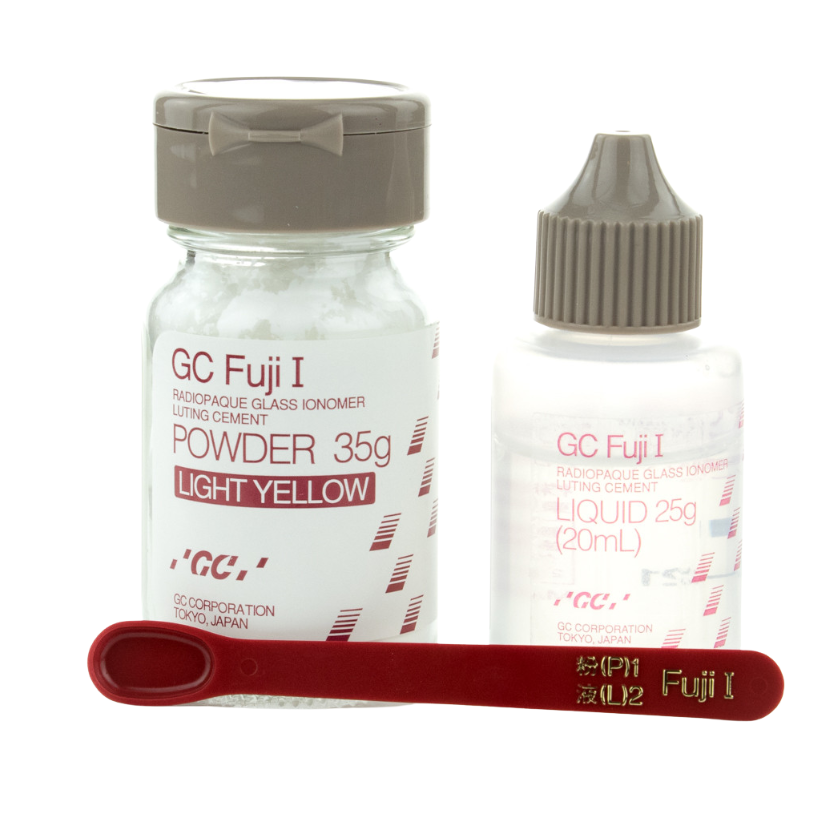
Fuji I Luting Cement
- Reliable Luting Cement — GC Fuji I provides conventional glass ionomer cementation for indicated indirect restorations.
- Strong Chemical Bond — bonds directly to tooth structure and metal.
- Self-Cured — no curing light is required.
- Moisture Tolerant — supports cementation when a completely dry field is difficult to achieve.
- Low Film Thickness — helps restorations seat smoothly.
- Fluoride Release — provides sustained fluoride release after placement.
- Easy Cleanup — rubbery consistency during setting helps remove excess cement.
KSh5,000.00
Product Description
Reliable Luting Cement for Indirect Restorations
Fuji I Luting Cement is a self-cured glass ionomer cement from GC, designed for the final cementation of crowns, bridges and other indirect restorations.
The cement chemically bonds to tooth structure and metal. As a result, it helps create a strong bond and maintain good marginal integrity.
Fuji I also tolerates some moisture during cementation. Therefore, it can be useful when achieving a completely dry field proves difficult.
The cement has a smooth, creamy consistency and a low film thickness. Consequently, restorations can seat easily while the cement provides reliable coverage.
In addition, Fuji I provides sustained fluoride release and excellent radiopacity. It is also resin-free, making it a useful option when a conventional glass ionomer luting cement is preferred.
At TransAfrica Medical Supplies, we supply professional dental materials from leading manufacturers. Furthermore, TransAfrica Academy provides product training to help dental teams improve product knowledge and clinical workflows.
Strong Chemical Adhesion
One of the main advantages of Fuji I is its chemical adhesion.
The cement bonds directly to tooth structure and metal. Therefore, clinicians can use Fuji I without a separate primer or adhesive for its standard glass ionomer bonding mechanism.
GC also highlights strong direct bonding to both precious and non-precious metals.
As a result, Fuji I can support cementation procedures involving metal-based crowns, bridges, inlays and posts.
Suitable for Metal and Opaque Zirconia Restorations
Fuji I is designed for several common indirect restorative procedures.
GC Europe lists Fuji I for metal-based and opaque zirconia restorations and posts. In addition, it can be used for cementation on implant abutments.
This makes Fuji I a practical option for dental practices that regularly perform fixed prosthodontic procedures.
However, clinicians should always confirm that the restoration material and clinical indication are suitable for Fuji I before cementation.
Smooth Consistency and Easy Seating
Fuji I has a smooth, creamy consistency.
Therefore, the cement can spread evenly across the internal surface of the restoration and support easy seating.
Its low film thickness also helps reduce interference during restoration placement.
In addition, Fuji I develops a rubbery consistency during setting. This allows clinicians to remove excess cement more easily at the appropriate stage.
Moisture-Tolerant Cementation
Maintaining ideal moisture control can sometimes be difficult during clinical procedures.
Fuji I offers a moisture-tolerant glass ionomer cement option. Therefore, it can be useful when a completely dry field cannot be assured.
However, moisture tolerance does not mean that the field should be contaminated. Instead, clinicians should follow the manufacturer's tooth preparation and cementation technique.
The prepared dentin should remain moist rather than excessively dried.
Fluoride Release
Fuji I provides sustained fluoride release after placement.
As a result, it can add the benefits of conventional glass ionomer technology to indirect restorative procedures.
Fluoride release is particularly relevant for practices that prefer glass ionomer luting materials as part of their restorative workflow.
Low Solubility and Marginal Integrity
Fuji I provides low solubility after setting. GC reports a solubility of approximately 0.06%.
Furthermore, the cement has a coefficient of thermal expansion similar to tooth structure.
These properties can help support marginal integrity during normal temperature changes in the oral environment.
Clinical Applications
According to GC, Fuji I can be used for:
- Final cementation of crowns
- Final cementation of bridges
- Cementation of metal inlays
- Cementation of metal onlays
- Cementation of porcelain-fused-to-metal restorations
- Cementation of suitable opaque zirconia restorations
- Cementation of posts
- Cementation on implant abutments
- Stainless steel crowns
- Orthodontic bands
- Selected orthodontic appliances
- Base or liner applications where indicated
Therefore, Fuji I can serve as a versatile luting cement for practices performing routine fixed prosthodontic and restorative procedures.
Always confirm the current indication for the specific Fuji I format you are using.
Simple Powder and Liquid Mixing
The conventional Fuji I format uses a powder-and-liquid system.
The manufacturer's current IFU specifies a 1.8 g powder to 1.0 g liquid ratio.
The standard mixing time is approximately 20 seconds. At 23°C, the working time is approximately 2 minutes, while the net setting time is approximately 2 minutes 30 seconds.
Therefore, clinicians have a defined working period for mixing, loading and seating the restoration.
The manufacturer's stated finishing time is approximately 4 minutes 30 seconds after seating at 37°C.
However, actual handling can vary with temperature, humidity, mixing conditions and clinical technique. Always follow the current IFU supplied with the product.
Fuji I Powder and Liquid
The powder-liquid format gives clinicians direct control over dispensing and mixing.
The standard package includes:
- 35 g powder
- 20 mL liquid
- Mixing pad
- Powder scoop
GC also provides separate powder and liquid refill options.
As a result, practices can maintain their preferred hand-mixing workflow and replenish individual components when required.
Fuji I Capsules
For faster and more consistent dispensing, Fuji I is also available in capsules.
The capsule format uses pre-measured powder and liquid. Therefore, it can simplify dispensing and reduce manual proportioning.
GC lists capsule packages with 48 capsules in the US/Canada range, while other GC markets list different package configurations.
Each US/Canada capsule contains approximately 0.33 g powder and 0.14 mL liquid.
Important: Package size and capsule quantity can vary by market. Confirm the exact SKU supplied in Kenya before placing an order.
What Should You Consider Before Buying?
Choosing the correct luting cement depends on your restoration and clinical workflow.
Restoration type
First, identify the restoration you plan to cement. Fuji I is particularly suited to metal-based and other indicated indirect restorations.
Material compatibility
Next, confirm the restoration material. GC specifically lists metal-based restorations and opaque zirconia among suitable applications.
Powder-liquid or capsule?
Choose powder-liquid if you prefer manual mixing and control over the working quantity.
Alternatively, choose capsules if your practice prefers pre-measured delivery.
Moisture control
Fuji I offers moisture tolerance. However, clinicians should still use appropriate isolation and avoid contamination during cementation.
Film thickness
If easy restoration seating is important, Fuji I offers a low film thickness and smooth consistency.
Cement removal
The rubbery consistency during setting can help simplify removal of excess cement.
Why Choose Fuji I Luting Cement?
Fuji I combines the core benefits of conventional glass ionomer technology with a simple cementation technique.
- Self-cured — no curing light is required.
- Chemical adhesion — bonds to tooth structure and metal.
- Moisture tolerant — useful when a completely dry field is difficult.
- Resin-free — suitable when a conventional glass ionomer cement is preferred.
- Low film thickness — supports easy seating of restorations.
- Fluoride release — provides sustained fluoride release.
- Excellent radiopacity — helps identify cement on radiographs.
- Low solubility — GC reports approximately 0.06% after setting.
- Smooth consistency — easy to mix and handle.
- Easy excess removal — rubbery consistency during setting helps cleanup.
- Multiple formats — available in powder-liquid and capsule formats.
Overall, Fuji I is a practical luting cement for dental practices that want reliable glass ionomer technology for indicated indirect restorations.
Frequently Asked Questions
What is Fuji I Luting Cement?
Fuji I is a self-cured glass ionomer luting cement manufactured by GC. It is designed mainly for the final cementation of crowns, bridges and other indicated indirect restorations.
Is Fuji I a glass ionomer cement?
Yes. Fuji I is a conventional, self-cured glass ionomer luting cement.
Is Fuji I resin-free?
Yes. GC describes Fuji I as a resin-free luting solution.
Does Fuji I require a curing light?
No. Fuji I is self-cured and does not require light activation.
Does Fuji I bond to teeth?
Yes. Fuji I chemically bonds to tooth structure.
Does Fuji I bond to metal?
Yes. GC states that Fuji I chemically bonds to metal and provides strong direct bonding to both precious and non-precious metals.
Does Fuji I require a primer or adhesive?
No separate primer or adhesive is required for its standard glass ionomer bonding mechanism.
Can Fuji I be used for crowns?
Yes. Fuji I is designed for final cementation of crowns.
Can Fuji I be used for bridges?
Yes. Fuji I is designed for final cementation of bridges.
Can Fuji I be used for zirconia?
GC Europe lists Fuji I for opaque zirconia restorations. Always confirm compatibility with the specific zirconia restoration and follow the manufacturer's instructions.
Can Fuji I be used for implant abutments?
Yes. GC Europe lists Fuji I as an option for cementation on implant abutments.
Does Fuji I release fluoride?
Yes. Fuji I provides sustained fluoride release.
What is the Fuji I powder-liquid ratio?
The manufacturer's IFU specifies a powder-to-liquid ratio of 1.8 g : 1.0 g.
How long does Fuji I take to mix?
The standard mixing time is approximately 20 seconds.
What is the working time?
At 23°C, the manufacturer's IFU gives a working time of approximately 2 minutes.
What is the setting time?
The net setting time is approximately 2 minutes 30 seconds under the manufacturer's stated test conditions.
What is the film thickness?
GC lists Fuji I with a low film thickness. Current GC product information lists approximately 15 µm for the capsule format.
What is Fuji I used for?
Fuji I is mainly used for cementing indicated crowns, bridges, inlays, posts and other indirect restorations. It is also used for selected orthodontic and stainless steel crown applications.
What is the difference between Fuji I and FujiCEM?
Fuji I is a conventional, self-cured glass ionomer luting cement. FujiCEM is a resin-reinforced glass ionomer luting cement supplied in a paste delivery system.
Therefore, they are not identical materials and should be selected according to the restoration and clinical technique.
Complete Your Luting Workflow
Fuji I works as part of a complete indirect restorative workflow.
Depending on the case, you may also need:
- Temporary cement
- Impression materials
- Retraction materials
- Mixing pads
- Cement spatulas
- Restoration cleaning materials
- Finishing and polishing systems
- Occlusal adjustment instruments
- Matrix and isolation products
- Implant prosthetic components
In addition, ensure that the restoration, tooth preparation and cementation procedure follow the manufacturer's recommendations.
Technical Specifications
| Specification | Fuji I Luting Cement |
|---|---|
| Manufacturer | GC Corporation |
| Product Type | Self-cured glass ionomer luting cement |
| Material | Conventional glass ionomer |
| Resin Content | Resin-free |
| Curing | Self-cured |
| Adhesion | Chemical adhesion to tooth structure and metal |
| Fluoride | Sustained fluoride release |
| Radiopacity | Excellent |
| Film Thickness | Approx. 15 µm for capsule format |
| Powder-Liquid Ratio | 1.8 g : 1.0 g |
| Mixing Time | Approx. 20 seconds |
| Working Time | Approx. 2 minutes at 23°C |
| Net Setting Time | Approx. 2 minutes 30 seconds |
| Finishing Time | Approx. 4 minutes 30 seconds after seating at 37°C |
| Powder-Liquid Package | 35 g powder + 20 mL liquid |
| Capsule Format | 48 capsules in US/Canada package |
| Capsule Contents | Approx. 0.33 g powder + 0.14 mL liquid per capsule |
| Solubility After Set | Approx. 0.06% |
| Main Uses | Crowns, bridges, inlays, posts, metal and indicated opaque zirconia restorations |
| Additional Uses | Stainless steel crowns, orthodontic bands and selected appliances |
Reviews
Clear filtersThere are no reviews yet.