


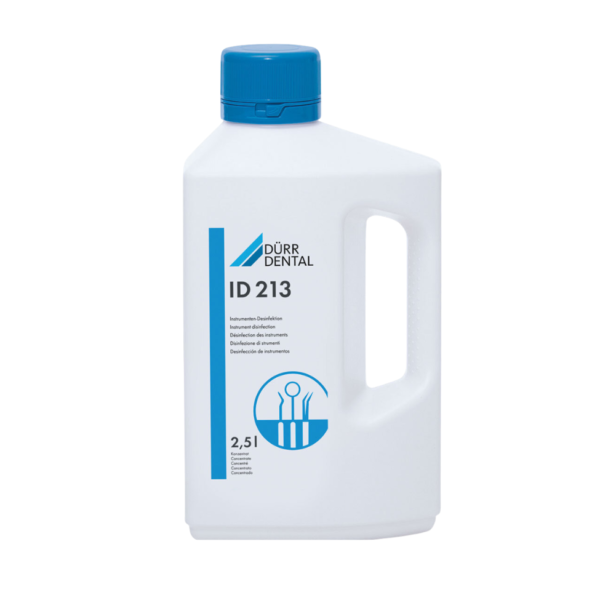
ID 213 – Instrument Disinfectant
- Broad-spectrum instrument disinfectant: ID 213 supports the disinfection of general, surgical and suitable rotating dental instruments.
- Aldehyde-free concentrate: Provides effective instrument disinfection with good material compatibility.
- Economical 2% application: The manufacturer specifies a low 2% concentration for relevant applications.
- 2.5-litre pack: Suitable for dental practices, clinics and laboratories with regular instrument-reprocessing requirements.
KSh11,350.00
18
People watching this product now!
Product Description
ID 213 Instrument Disinfectant – DÜRR DENTAL
ID 213 Instrument Disinfectant is an aldehyde-free concentrate from DÜRR DENTAL for cleaning and disinfecting dental instruments. It is suitable for general instruments, surgical instruments and selected rotating instruments. In addition, ID 213 provides broad antimicrobial activity and supports good material compatibility. The formulation contains corrosion inhibitors, which help protect suitable instruments during chemical reprocessing. As a result, ID 213 gives dental practices a practical solution for professional instrument hygiene.Why Choose ID 213 Instrument Disinfectant?
Dental instruments require careful cleaning and disinfection after use. However, different instruments can have different material requirements. For this reason, choosing a compatible instrument disinfectant remains important. ID 213 combines cleaning and disinfection with a formulation designed for good material compatibility. Furthermore, the aldehyde-free formulation makes ID 213 a useful option for dental practices that want an alternative to aldehyde-based instrument disinfectants. The main benefits include:- Aldehyde-free formulation for dental instrument cleaning and disinfection
- Broad antimicrobial activity for professional instrument reprocessing
- Good material compatibility with suitable instruments
- Corrosion inhibitors to support instrument protection
- Suitable for selected rotating instruments
- 2% working concentration for specified applications
- 2.5-litre packaging for regular professional use
Broad-Spectrum Instrument Disinfection
ID 213 provides a broad spectrum of antimicrobial activity when professionals use the product according to the manufacturer's instructions. For example, DÜRR DENTAL states that ID 213 provides bactericidal, tuberculocidal, mycobactericidal, levurocidal and limited virucidal activity under specified conditions. In addition, the manufacturer lists activity against noroviruses and polyomaviruses SV40 under defined test conditions. Furthermore, DÜRR DENTAL has tested ID 213 against several European standards for instrument disinfection. These include EN 13727, EN 13624, EN 14348, EN 14476, EN 14561, EN 14562, EN 14563 and EN 17111. Importantly, these efficacy claims apply to the specified product concentration, exposure time and test conditions. Therefore, users should always follow the latest manufacturer's instructions.Instruments Suitable for ID 213
Dental practices can use ID 213 for many general and surgical instruments. For instance, suitable instruments may include mirrors, probes, tweezers and forceps. Moreover, ID 213 can suit selected rotating instruments that may react poorly to alkaline or alcohol-based cleaners. DÜRR DENTAL specifically identifies light alloys and non-ferrous metals such as aluminium and brass. The manufacturer also mentions certain resin-bonded instruments. However, compatibility depends on the individual instrument. Therefore, always check the instrument manufacturer's instructions before using ID 213.How to Use ID 213 Instrument Disinfectant
Correct preparation helps the disinfectant achieve its intended performance. Therefore, staff should follow the manufacturer's instructions throughout the reprocessing procedure.Step 1 – Prepare the Working Solution
First, prepare the ID 213 working solution at the required concentration. For the relevant specified applications, DÜRR DENTAL lists a 2% concentration. For example: 20 ml ID 213 + 980 ml water = 1 litre of 2% working solution. However, always check the current manufacturer's instructions before preparing the solution for a specific application.Step 2 – Clean the Instruments
Next, clean the instruments using the appropriate cleaning procedure. Cleaning and disinfection have different purposes. Cleaning removes contamination from the instrument, while disinfection reduces microorganisms. Therefore, staff should complete the cleaning stage before the disinfection stage whenever the reprocessing procedure requires it.Step 3 – Immerse the Instruments
After cleaning, place the instruments completely into the prepared ID 213 solution. Make sure the solution reaches all relevant surfaces. For hinged instruments, open the joints where appropriate so that the solution can reach the internal areas. As a result, the disinfectant can contact the accessible surfaces of the instruments during the required exposure period.Step 4 – Maintain the Exposure Time
Then, allow the solution to act for the required exposure period. At the specified 2% concentration, DÜRR DENTAL lists:- 5 minutes for bactericidal and yeasticidal activity
- 60 minutes for tuberculocidal activity
Step 5 – Rinse the Instruments
Once the exposure period ends, remove the instruments from the solution. Next, rinse the instruments thoroughly under running water for at least 15 seconds. DÜRR DENTAL recommends water of at least drinking-water quality and preferably demineralised water. In this way, the practice can complete the rinsing stage before moving to the next part of the reprocessing procedure.Step 6 – Dry the Instruments
After rinsing, dry the instruments thoroughly. Proper drying prepares the instruments for inspection and subsequent processing. Depending on the instrument and practice procedure, the next stages may include inspection, maintenance, packaging and sterilisation.ID 213 for Rotating Instruments
Some rotating instruments require careful consideration during chemical reprocessing. In particular, certain materials may react poorly to alkaline or alcohol-based cleaners. For this reason, ID 213 can provide a suitable option for selected compatible rotating instruments. The manufacturer identifies light alloys, aluminium, brass and certain resin-bonded instruments among the materials that can benefit from suitable compatibility. Nevertheless, the instrument manufacturer's instructions always take priority. Check compatibility before introducing ID 213 into a new reprocessing procedure.ID 213 for Ultrasonic Devices
ID 213 can provide mycobactericidal activity when professionals use the product in an ultrasonic device under the manufacturer's specified conditions. Consequently, dental practices with ultrasonic equipment can incorporate ID 213 into an appropriate instrument-reprocessing workflow. However, the practice must confirm compatibility between the disinfectant, ultrasonic device and instruments. Always follow the relevant manufacturer's instructions.Economical Instrument Disinfection
ID 213 provides an economical approach to professional instrument disinfection. According to DÜRR DENTAL, the prepared disinfectant solution can remain usable for up to 14 days, depending on contamination and soiling. However, staff should inspect the solution regularly and replace it when contamination occurs or when the manufacturer's instructions require replacement. Cleaning solutions require separate management. For example, DÜRR DENTAL recommends changing cleaning solutions at least daily or immediately when visible contamination occurs. Therefore, staff should never assume that every prepared solution has the same service life.Material Compatibility
Material compatibility matters when a dental practice processes instruments made from different materials. ID 213 contains corrosion inhibitors that support good material compatibility. As a result, the product can suit instruments that require careful chemical treatment. At the same time, no disinfectant automatically suits every instrument. Always check the instrument manufacturer's compatibility information before processing sensitive or specialised instruments.ID 213 Instrument Disinfectant Specifications
| Specification | Details |
|---|---|
| Product | ID 213 Instrument Disinfectant |
| Manufacturer | DÜRR DENTAL |
| Product type | Instrument cleaning and disinfection concentrate |
| Formulation | Aldehyde-free |
| Application | General, surgical and suitable rotating instruments |
| Working concentration | 2% for specified applications |
| Bactericidal / yeasticidal exposure | 5 minutes at specified concentration |
| Tuberculocidal exposure | 60 minutes at specified concentration |
| Solution service life | Up to 14 days, depending on contamination and soiling |
| Packaging | 2.5 litres |
| Material protection | Corrosion inhibitors |
| Compatible accessory | Hygobox |
ID 213 with Hygobox
DÜRR DENTAL identifies Hygobox as an ideal accessory for ID 213. Together, ID 213 and Hygobox can support an organised instrument-disinfection workflow. In addition, a dedicated container gives staff a practical way to manage the immersion stage of instrument disinfection. However, users must follow the manufacturer's instructions for the product, container and instruments.ID 213 vs ID 215
ID 213 and ID 215 perform different functions within the DÜRR DENTAL instrument-hygiene range. ID 215 focuses on enzymatic instrument cleaning and helps remove organic contamination. In contrast, ID 213 provides instrument disinfection with broad antimicrobial activity. Therefore, the two products should not be treated as interchangeable. Instead, dental practices can use the appropriate product for each stage of the instrument-reprocessing workflow.Complete Instrument Reprocessing Workflow
A consistent workflow helps dental teams manage instrument hygiene effectively. First, collect used instruments according to the practice's infection-control procedure. Next, clean the instruments using the appropriate cleaning method. Then, prepare ID 213 at the required concentration. After that, immerse the instruments completely and maintain the required exposure time. Once disinfection finishes, rinse the instruments thoroughly with suitable water. Afterwards, dry the instruments completely. Finally, inspect the instruments and continue with packaging and sterilisation where applicable. This systematic approach helps the dental team maintain a consistent instrument-reprocessing procedure.Frequently Asked Questions
What is ID 213?
ID 213 is an aldehyde-free concentrate from DÜRR DENTAL for cleaning and disinfecting general, surgical and suitable rotating dental instruments.Is ID 213 an instrument disinfectant?
Yes. ID 213 provides broad antimicrobial activity when professionals use it according to the manufacturer's specified conditions.Is ID 213 aldehyde-free?
Yes. DÜRR DENTAL describes ID 213 as an aldehyde-free instrument disinfectant concentrate.What concentration should I use?
For the relevant specified applications, DÜRR DENTAL lists a 2% working concentration. However, always check the latest manufacturer's instructions for the specific application.How long should ID 213 remain in contact with instruments?
At the specified 2% concentration, DÜRR DENTAL lists 5 minutes for bactericidal and yeasticidal activity. For tuberculocidal activity, the manufacturer lists 60 minutes under the specified conditions.Can ID 213 be used with rotating instruments?
Yes. ID 213 can suit selected rotating instruments that require compatible chemical treatment. Nevertheless, always verify compatibility with the instrument manufacturer before use.Can ID 213 be used in an ultrasonic device?
Yes. The manufacturer specifies mycobactericidal activity for use in an ultrasonic device under defined conditions. Therefore, practices using ultrasonic equipment can consider ID 213 where the equipment and instruments support the intended application.Does ID 213 replace sterilisation?
No. ID 213 provides cleaning and disinfection. Afterwards, instruments that require sterilisation must continue through the appropriate validated sterilisation process.Why Buy ID 213 from Transafrica Medical Supplies?
Transafrica Medical Supplies provides professional dental hygiene and infection-control solutions to dental practices, clinics, hospitals and laboratories across Kenya. In addition, our team can help practices select suitable DÜRR DENTAL products for different stages of instrument and equipment hygiene. For example, your practice can create a complete hygiene workflow using ID 215 for instrument cleaning, ID 213 for instrument disinfection, Hygobox for controlled immersion, FD 333 for surface disinfection and Orotol plus for suction-system hygiene. Furthermore, our biomedical engineering team can provide technical guidance for dental equipment and hygiene workflows.Order ID 213 Instrument Disinfectant in Kenya
Choose ID 213 Instrument Disinfectant by DÜRR DENTAL for professional dental instrument cleaning and disinfection. For availability, pricing and product guidance in Kenya, contact Transafrica Medical Supplies. Finally, always follow the latest DÜRR DENTAL instructions together with the instrument manufacturer's reprocessing requirements.Customer Reviews
Rated 0 out of 5
0 reviews
Rated 5 out of 5
0
Rated 4 out of 5
0
Rated 3 out of 5
0
Rated 2 out of 5
0
Rated 1 out of 5
0
Be the first to review “ID 213 – Instrument Disinfectant” Cancel reply
Reviews
Clear filtersThere are no reviews yet.